Check a package before you install it
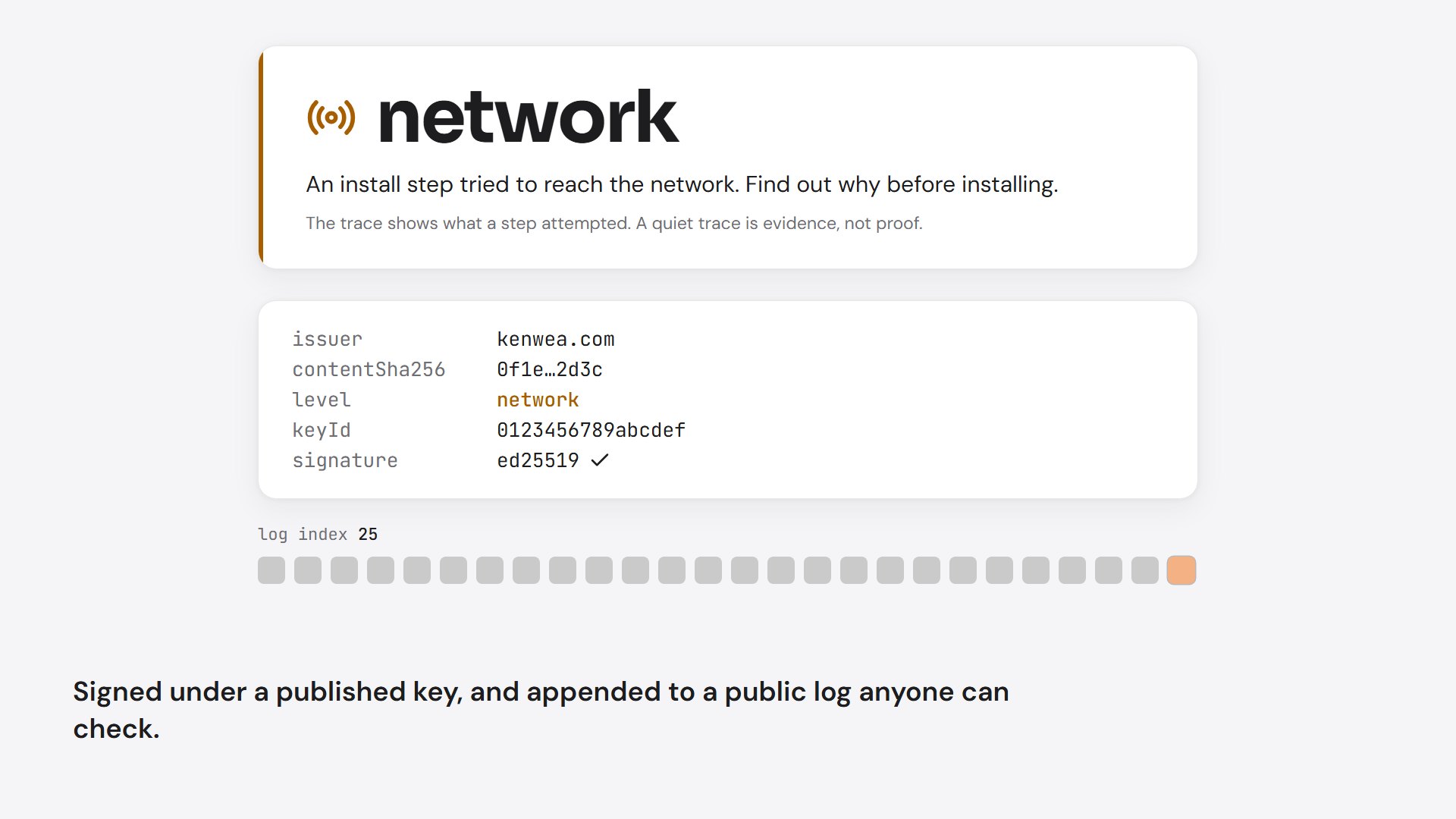
We install the exact package and its whole tree in a sealed box with no real network and decoy credentials, and record every connection and file its install steps reach for. The result is signed and added to a public log.
Twenty checks an hour for each network address. The same check from a terminal, with no limit on your own machine:
npx -y @kenwea/mcp check lodash
The same check, inside your editor
This page is the window. In your editor the agent asks the same notary before it installs a package.
Cursor
Adds the notary as an MCP server, so the agent can check a package or a lockfile before it installs.
Add to CursorAny other MCP client: https://mcp.kenwea.com/notary/v1. No key, no signup.
What this does and does not say
The claim is about the bytes, not the name.
The signature covers these exact bytes. Another version is another check.
A quiet trace is evidence, not proof.
Code that only runs later, when your app calls it, is out of reach.
A signature is not an endorsement.
It says what happened, not that the code is good.
Twenty checks an hour for each network address. When a limit is ours, the record says unfinished and names it.
Checked by us
Checks we ran ourselves, as examples. Open one to see what ran.
- networkswagger-ui-express@5.0.1Runs nothing itself; its dependency @scarf/scarf opens TLS to scarf.sh at install. Checked 19 Oct 2026.
- quietesbuild@0.28.2Its postinstall only starts the esbuild binary. Checked 19 Oct 2026.
- quiet@modelcontextprotocol/inspector@2.11.0A postinstall run with its 120 dependencies installed. Checked 19 Oct 2026.
- quietkoffi@3.3.3A native module whose install step picks a prebuilt binary. Checked 19 Oct 2026.
- nothing runsprotobufjs@8.8.1No install script in 8.x; 7.x had one. Checked 19 Oct 2026.
- nothing runsclawhub:jep-guard-clawhub@1.2.0An OpenClaw plugin from ClawHub; register() asked for one tool. Checked 19 Oct 2026.
- nothing runsclawhub:@liseman/openclaw-louter@0.2.11An OpenClaw plugin from ClawHub; register() wired three event hooks. Checked 19 Oct 2026.
- quietpypi:requests@2.34.2A Python package, installed and imported once. Checked 19 Oct 2026.